Published: 3 March 2015 | Updated: 30 September 2026 | Author: Smart Vision Optometry
Editorial and clinical update — 30 September 2026: The original 2015 story below is preserved, including its wording and the individual case experience. The story describes one child and should not be read as evidence that juggling or behavioural/perceptual vision therapy improves learning, confidence or school performance generally. Current AAPOS guidance distinguishes treatment of specific diagnosed eye-movement or binocular problems from behavioural/perceptual vision therapy claims for learning disabilities.
There is research to suggest that a therapeutic goal should be to teach the child to acquire correct eye-hand coordination, as this represents a fundamental prerequisite for sensory integration [1]. Bilateral integration skills, spatial awareness, motion and depth perception, and tracking are further skills that come into play when eye-hand coordination is promoted and encouraged. There is also research to suggest that acquiring skills such as these can lead to improved confidence, social skills and self-esteem [2]. So taking this into consideration, it is difficult to understand why we wouldn’t want to throw bean bags at children all day long. In fact, I am going to tell you a story as to why it is actually a great therapeutic activity!
VISION THERAPY AND EYE-HAND COORDINATION: LET’S JUGGLE!
Not long ago, a little girl walked into my vision therapy room. It was not the first therapy room she had been in. It will not be the last. But according to her parents, it was the first one that she was able to walk away from and say: “Hey, I learnt something!” This is not to say she did not learn anything elsewhere. Quantifiably her speech and language skills had improved, her gross motor control had improved and her school reports had improved.
But numbers on pages do not mean much to children. They don’t care that they climbed from the 2nd percentile to the 50th percentile. They care that they are able to keep up in class; that they can play handball with the other kids; that they feel like they fit in. For this little girl in particular, she cared because I taught her something she could do at her school talent quest. Something that would make all the other kids think she was cool and something that would make her feel special. What did I teach her, you may ask? I taught her how to juggle.
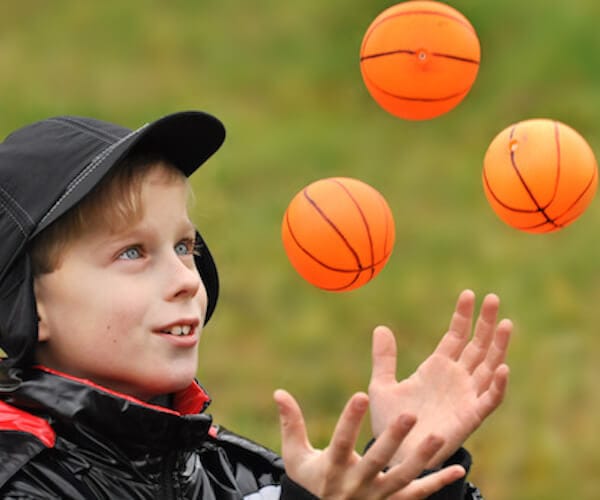
Now please don’t go thinking I am going to run off to join the circus with all of my vision therapy patients. I am in no way that talented (what a shame!) There were only two bean bags involved, there were a lot bean bags thrown haphazardly across the room and there was lots of laughter. Slowly, but surely, this shy little 8-year-old girl learnt how to track the bean bags back and forth between her two hands. She learnt to cross her body midline in an efficient way and learnt how important it was for her eyes to maintain consistent fixation on a moving target. She learnt how to locate that target in space and how to remember a sequence of steps that would ensure success – up, grab, catch.
When she was able to follow the steps accurately and maintain her concentration, she was able to complete the task. In the end, she was running off to show both parents, the staff at reception and anyone who would listen in the waiting room. She became excited, confident in her ability and the bit I liked the most? She smiled. She walked away smiling to herself knowing she had just achieved something. And that is the crux of it – no matter how big or how small, every success should be celebrated, admired and broadcasted. For me that was only 20 minutes of a 45-minute session of an 8-hour day. For her, the whole world stopped and she realised that she was good at something. She could do something special. And if she could learn to juggle in 20 minutes, then what is to stop her from learning all the other skills I have planned over the course of her vision therapy program?
[1] Kenefick, J. Behavioural optometric care for rehabilitation of CVA trauma and other stable brain compromised vision disorders. Behav Optom 1990; June/July: 23-26.
[2] Bergland, C. Hand-eye coordination improves cognitive and social skills: researcher’s link hand-eye coordination to learning, cognition and sociability. The Athletes Way 2013.
Current evidence and clinical context
AAPOS guidance on vision therapy notes that orthoptic exercises can help selected diagnosed eye-movement problems such as convergence insufficiency, while behavioural/perceptual vision therapy has not been shown to improve learning disabilities. Coordination activities may be part of an individual programme, but their purpose, evidence and expected outcomes should be discussed for the specific condition being treated.
If a child has blur, double vision, headaches, failed vision screening or other visual symptoms, an eye examination can identify treatable ocular conditions. Educational or developmental concerns should continue to be assessed through the appropriate educational or health professionals rather than attributed to one visual behaviour.
Related Smart Vision reading
Vision therapy and its evidence · Vision problems in children · Visual demands in sport
Frequently asked questions
What is eye-hand coordination?
Eye-hand coordination is the use of visual information to guide hand movements during activities such as catching, writing, drawing and sport.
Does learning to juggle prove vision therapy will improve learning or school performance?
No. This article describes one child’s experience. AAPOS guidance does not support behavioural or perceptual vision therapy as a treatment for learning disabilities, and an individual activity cannot guarantee broader learning or performance outcomes.
When should a child have an eye assessment?
An eye assessment is appropriate when there are visual symptoms, a failed vision screening or concerns about an eye condition. Any diagnosed eye problem can be managed for its own clinical purpose while educational or developmental concerns are assessed separately.