
Sydney Optometrists Highlight Long-Term Risks of High Myopia
While glasses and standard contact lenses correct blurred distance vision, they do not slow the structural changes occurring inside the eye.
Myopia (short-sightedness), once considered a simple refractive inconvenience, is increasingly recognised as a progressive eye condition with potential long-term health implications.
With childhood short-sightedness continuing to rise across Australia, optometrists are reporting strong interest in treatments that offer both daytime freedom from glasses and strategies to slow eye growth in younger patients.
The prevalence of myopia (near‑sightedness) is rising worldwide, and with it, the importance of early intervention and long‑term wellness care.
Myopia—often called short-sightedness—has surged to become one of the most common causes of visual impairment worldwide. As incidence rises in children and adults alike, it has become a pressing public health issue demanding awareness and action. According to Gary Rodney, founder and creator of Smart Vision Optometry, Master of Optometry, Behavioural Optometrist and Fellow of…
Why This Matters Myopia (short‑sightedness) is rising globally, especially among children. It’s not just about needing glasses — high myopia increases risks of eye disease later in life. A proactive approach is now possible: orthokeratology (Ortho‑K) combined with behavioural optometry and vision therapy offers a way to manage and slow the progression of myopia, while…
The number of children developing myopia (short-sightedness) is increasing at an alarming rate, with younger children being diagnosed at a growing pace. Despite this, a global survey has found that one in four parents do not understand the term “myopia” or the potential long-term impact it can have on their child’s eye health and quality…
Myopia, or short-sightedness, is on the rise at an alarming rate. What was once a relatively uncommon condition is now affecting nearly a third of the global population, and projections suggest that by 2050, half of the world’s people may have a significantly high degree of myopia. Australian Smart Vision behavioural optometrist Gary Rodney, a…
Short-Sighted Athletes Can Succeed With 32% of the world’s population affected by myopia, it’s no surprise that short-sighted individuals can be found in every field, including sports. Yet, the stereotype persists that clear vision is a prerequisite for athletic success, leaving many myopic individuals hesitant to pursue sports. “Being short-sighted doesn’t mean giving up on…
Insights from Smart Vision Behavioural Optometrists on Myopia Management Despite significant advances in myopia control, many still perceive short-sightedness as an unavoidable condition. Gary Rodney, founder of Smart Vision Optometry in Sydney, and Jacquie Gattegno, principal senior Smart Vision behavioural optometrist at Eyes InDesign Smart Vision Optometry Bondi, emphasise the importance of understanding myopia and…
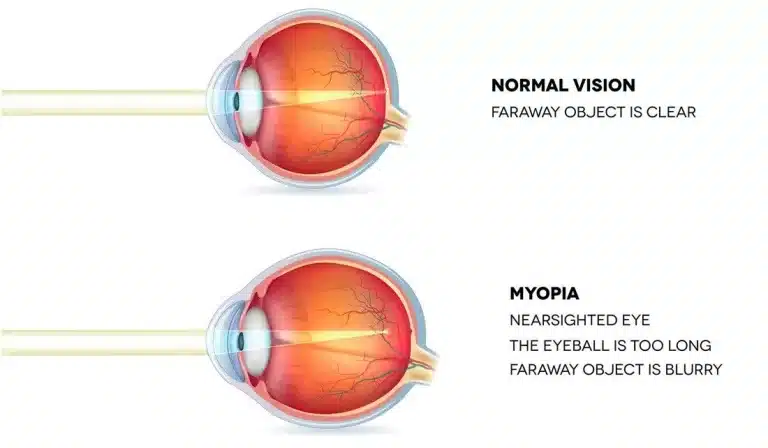
Myopia (nearsightedness) is a condition in which close objects are visibly clear, while distanced objects are blurred. This is understood as a refractive disorder that occurs as the eyeball elongates (gets longer). Myopia can cause exponentially more serious complications if the refractive error is severe
Myopia is the most common eye disorder in the world, and the biggest cause of visual impairment, especially in children, according to Australian behavioural optometrist Jacqueline Gattegno
Most stereotypes are based on prejudice, but occasionally, one pops up that’s based on fact – even if only remotely. “Smart kids wear glasses” could be among them, at least up to a point. Australian behavioural optometrist Jacqueline Gattegno sheds light on what is known regarding the intriguing link between myopia and IQ.
One part of the brain conjures up an image based on the data it receives from the eyes. Other parts of the brain interpret it. The gift of sight involves much more than just the eyes.
Nearsightedness Explained Despite advances in myopia control, most people still think that short-sightedness is just something that happens. “Most people think that you’re either short-sighted or you’re not,” says Gary Rodney, an internationally-recognised Fellow of the Academy of Orthokeratology and Myopia Control based in Sydney. “They also see the progression of myopia as being inevitable,…
Nutrition And Nearsightedness Many people will remember their grandmothers telling them to eat carrots for better eyesight, but these ladies were only partly correct. As with so many health-related questions, the answer to the question of what foods can help in the fight against myopia is: “It’s complicated.” Australian behavioural optometrist Jacqueline Gattegno explains the…
Nearsightedness Uncovered As the number of children with myopia keeps growing at an epidemic rate, and impacting on an increasing proportion of younger children, a global survey has shown that one in four parents don’t know the meaning of the term, myopia, or the seriousness of the impact it can have on their children’s eyes…
Shortsightedness Prevention, Control And Management A recent growth in the focus on awareness and management of Myopia (shortsightedness) and a new emphasis and direction in terms of treatments evidenced in new studies and developments, seems to have resulted in a new approach to the ever-growing threat to the world provided by this multi-levelled refractive error….
For at least four centuries, people have been looking for a way to explain the prevalence of myopia (shortsightedness), what causes it, and how to cure this eye disorder that currently affects millions of people’s vision, and in some instances results in vision loss and blindness. According to Australian behavioural optometrist and fellow of the International…
The myopia (shortsightedness) epidemic, predicted to affect half of the world’s population by 2050, is racing even faster towards this target with the numbers boosted by the Covid-19 pandemic’s enforced indoor and screen-watching lifestyles. However, a study is now suggesting that perceptual learning may, literally, shine at least some light at the end of this…
End of content
End of content