Published: 22 July 2020 | Updated: 30 September 2026 | Author: Smart Vision Optometry
Editorial and clinical update — 30 September 2026: The original article/interview below is preserved, including its attributed quotations and editorial structure. Current evidence and guidance below should be relied on where older wording differs.
Australian behavioural optometrists Gary Rodney and Jacqueline Gattegno have responded with concern to statistics showing that 5 to 10 percent of preschool children, and 25 percent of their slightly older brothers and sisters at grade school, have vision problems. Yet, in spite of this, about 80 percent of the knowledge is transmitted on screens situated some distance away from them in today’s classrooms and lecture halls, which makes it difficult for them to assimilate the knowledge.
Rodney, a fellow of the International Academy of Orthokeratology and Myopia Control (FIAOMC), says not enough consideration is being given to those children whose ability to learn is compromised because of refractive, perceptual and vision impairments which prevent them from seeing and processing relevant information. Instead technology is taking over the classroom and, in many cases, the use of screens and computers is increasing the progression of eye impairments like myopia.
Home Screentime Gets the Blame
“While the debate continues as to whether too much screen time at home could be causing or worsening eye problems, the school screen time or computer usage, which also calls for fixed focus and very little blinking over long periods, is seldom addressed.
Instead, it’s often seen as a feather in the cap of educational institutions keen to prove they’re keeping up with the times. And this is despite studies which report big leaps in the percentage of students with vision problems like myopia as their educational paths continue in a world where shortsightedness has reached epidemic proportions,” says Rodney.
He said one out of four school-goers are myopic (nearsighted) and can see objects clearly only when they are close by. When faced with images or texts some distance away, everything becomes a confusing blur which leaves them understanding very little about the meaning or relevance of what they are seeing.
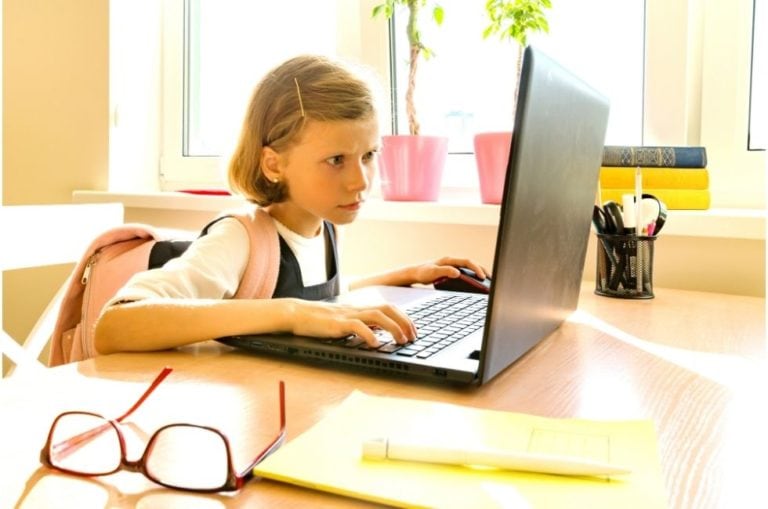
And they are not alone on this situation. According to Rodney, many children with other eye impairments face similar difficulties. And there’s a flip side to the problem – its not only screens that are further away that lead to difficulty with perceptual vision. A nearby screen like an individual computer on the desk, also holds an assortment of risks like fixed distance focus, the negative effects of the blue light emitted by the screen, and a tendency not to blink, which can lead to dry eye and eye strain in the same way as home computers, mobile phones and tablets.
Rodney said it’s possible that more hours are now spent viewing screens at school than at home, and certainly more time will be spent indoors doing so during class. And these are two of the major concerns with regard to increasing the rate of progression of this epidemic level eye impairment.
Kids Dealing With a Bundle of Confusion
For children with myopia starting school this adds to the normal concerns about whether children will like or shun them, and if their performance will be good enough to elicit praise from their parents and teacher.
When the knowledge they’re supposed to absorb is displayed a full classroom length away, they may well give up completely on concepts like learning, best behaviour, and “doing well at school”, and end up with limited attention spans, poor engagement and performance, affected social development and a low self-image, all of which will feed the vicious cycle they create. And at the same time the core factor of the eye impairment itself could be getting worse.
“What are they supposed to feel when their teacher asks a question about something on a screen, and they can’t answer it because what they see doesn’t make sense? Or they battle to read out loud words which are a blur to them on a screen or whiteboard, and everyone around them starts laughing?” asks Gattegno.
HEAR: Gary Rodney Interviewed By David Wood Ultra106five.com
The Need for Eye Checks
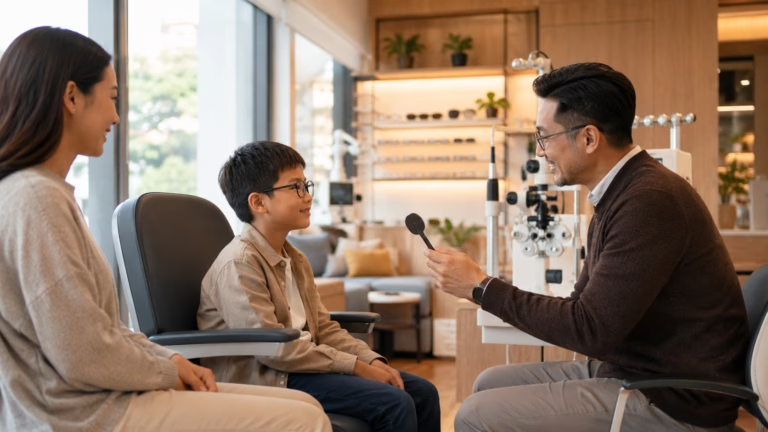
Rodney and Gattegno urge parents and schools to ensure that children have regular eye checks in a bid to pick up any signs of impairment as soon as possible so those affected can be treated immediately.
For more information visit the Smart Vision website: Optometrists Sydney: Optometry Services For Children and Adults | Smart Vision; for specific information about Myopia treatment and prevention visit Myopia Prevention: Solutions, Control And Treatment In Sydney; and for detailed information about Myopia Treatment visit Orthokeratology In Sydney: The Non Surgical Alternative.
Book an appointment for a thorough eye check-up or Call the Bondi clinic on (02) 9365 5047 or the Mosman clinic on (02) 9969 1600.
Current evidence and clinical context
AAPOS guidance distinguishes learning difficulties from coexisting eye conditions.
The original article’s classroom and prevalence percentages are not verified measures for every school. Its blue-light wording should not be interpreted as proof of retinal damage from normal device use. Keep educational assessment and support in place.
Related Smart Vision reading
Teachers and vision concerns · Screen discomfort
Frequently asked questions
What if a child cannot see the classroom display clearly?
Arrange eye assessment and discuss suitable access adjustments with the school.
Does that explain every learning difficulty?
No. Other factors may need assessment.
Should learning support continue during eye care?
Yes. Keep appropriate support in place.