Surge in Childhood Myopia Prompts Call for Early Intervention
Myopia (short-sightedness), once considered a simple refractive inconvenience, is increasingly recognised as a progressive eye condition with potential long-term health implications.
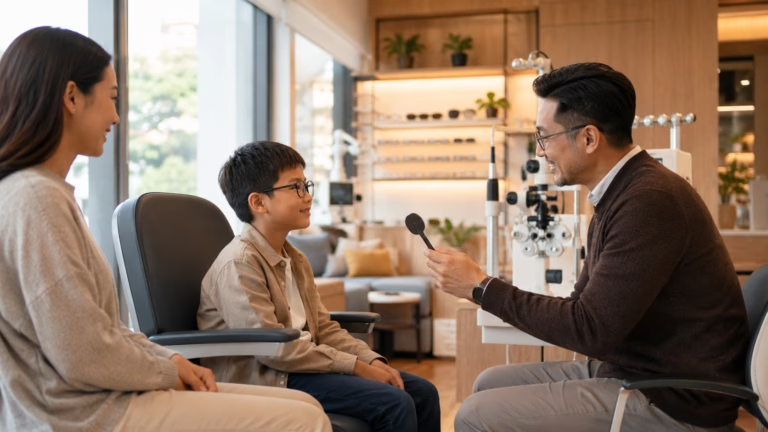
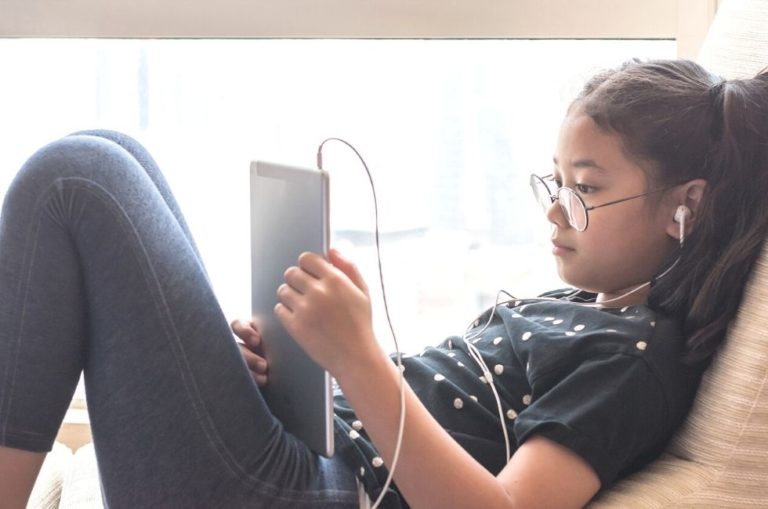
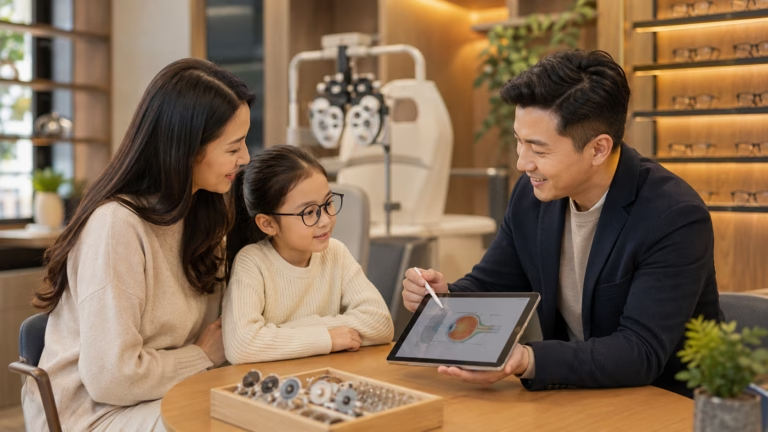
With childhood short-sightedness continuing to rise across Australia, optometrists are reporting strong interest in treatments that offer both daytime freedom from glasses and strategies to slow eye growth in younger patients.
The prevalence of myopia (near‑sightedness) is rising worldwide, and with it, the importance of early intervention and long‑term wellness care.
Myopia is the most common eye disorder in the world, and the biggest cause of visual impairment, especially in children, according to Australian behavioural optometrist Jacqueline Gattegno
Most stereotypes are based on prejudice, but occasionally, one pops up that’s based on fact – even if only remotely. “Smart kids wear glasses” could be among them, at least up to a point. Australian behavioural optometrist Jacqueline Gattegno sheds light on what is known regarding the intriguing link between myopia and IQ.
With 32 percent of the world’s population living with myopia, it’s not surprising that there are short-sighted people in all walks of life. But it may surprise some folks to know just how many of them are top athletes. After all, the image of a glasses-wearing sportsperson is something that isn’t exactly mainstream. However, there’s…
Nearsightedness Explained Despite advances in myopia control, most people still think that short-sightedness is just something that happens. “Most people think that you’re either short-sighted or you’re not,” says Gary Rodney, an internationally-recognised Fellow of the Academy of Orthokeratology and Myopia Control based in Sydney. “They also see the progression of myopia as being inevitable,…
It is said that the eyes are the windows to the soul, but they are also the windows through which people are able to perceive the world around them. Fortunately, taking care of them isn’t difficult, and many of the steps that should be taken to keep eyes healthy will be good for overall health…
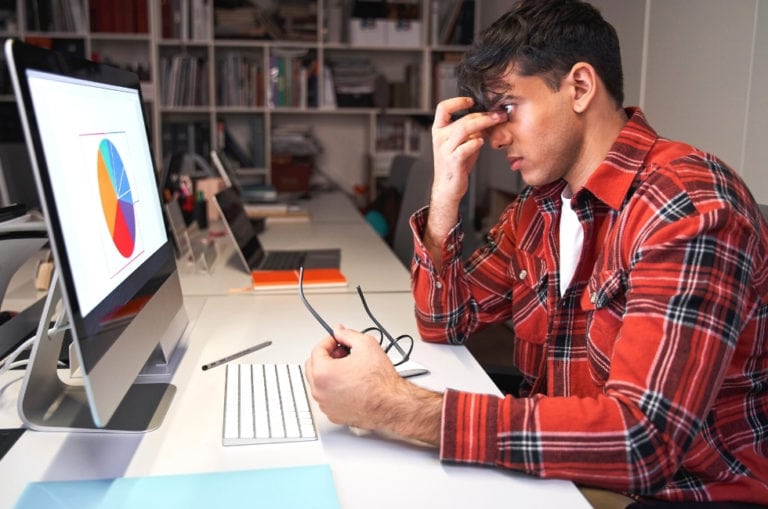
For students, long hours spent in front of the computer go with the territory. Finally, they graduate, and embark on their chosen career – which, for many people, involves even more hours of screen time. At the end of a long day’s work or study, most folks will feel symptoms of mild eye strain, and…
Nearsightedness Uncovered As the number of children with myopia keeps growing at an epidemic rate, and impacting on an increasing proportion of younger children, a global survey has shown that one in four parents don’t know the meaning of the term, myopia, or the seriousness of the impact it can have on their children’s eyes…
Eyes are considered the primary sense because they gather 80% of the information necessary for enabling people to see the world around them. But the other senses, hearing, touch, taste and smell, are not just hangers on that add some colour to a dull picture. They are valuable parts of the team that add perception…
Life Without Daytime Glasses | Smart Vision Optometry, Sydney It’s called Orthokeratology, and it involves using contact lenses. But instead of someone wearing contacts by day, says Sydney behavioural optometrist and fellow of the International Academy of Orthokeratology and Myopia Control (FIAOMC), Gary Rodney, they will be wearing them while they sleep. Orthokeratology, or Ortho-K,…
Shortsightedness Prevention, Control And Management A recent growth in the focus on awareness and management of Myopia (shortsightedness) and a new emphasis and direction in terms of treatments evidenced in new studies and developments, seems to have resulted in a new approach to the ever-growing threat to the world provided by this multi-levelled refractive error….
For at least four centuries, people have been looking for a way to explain the prevalence of myopia (shortsightedness), what causes it, and how to cure this eye disorder that currently affects millions of people’s vision, and in some instances results in vision loss and blindness. According to Australian behavioural optometrist and fellow of the International…
The myopia (shortsightedness) epidemic, predicted to affect half of the world’s population by 2050, is racing even faster towards this target with the numbers boosted by the Covid-19 pandemic’s enforced indoor and screen-watching lifestyles. However, a study is now suggesting that perceptual learning may, literally, shine at least some light at the end of this…
Sleep, and plenty of it, is usually recommended as one of the top ways to help the body and our eyes recover from illnesses and other setbacks. But it’s not necessarily the right answer for glaucoma, an eye condition which moves from affecting peripheral vision only, to ultimately destroying the ability to see, says Gary…
Along with the changes in lifestyles and technology in the past couple of decades, came similar changes in classrooms, teaching, the way in which information is provided and received, and the environment in which it is delivered. Technology and screens have become a big part of teaching, providing fast and easy access to information, and…
With homeschooling becoming increasingly popular even before Covid-19 lockdowns made it a must, more families, armed with lockdown experience and easy access to digital material, are likely to choose this way to educate their children. But eye vision experts like Australian behavioural optometrist and fellow of the International Academy of Orthokeratology and Myopia Control (FIAOMC),…
The Covid-19 pandemic and its lockdowns haven’t only impacted on the health, economic and business sectors. Studies and surveys show they have also taken a heavy toll on eye health. And the rise in the prevalence and severity of vision disorders, errors and diseases, is especially evident in the increase in digital eye strain and myopia (nearsightedness) among young…
Since 2000 global stress levels have soared to a point where in some countries it affects close to 60% of the population. The WHO labeled it as the epidemic of the 21st century, way before the COVID-19 pandemic sent it spiraling even higher, and studies show stress could be responsible for 95% of visits to…
End of content
End of content