Published: 19 April 2021 | Updated: 28 September 2026 | Author: Smart Vision Optometry
Editorial and clinical update — 28 September 2026: The original article/interview body below is retained in its editorial form, including its attributed quotations and narrative structure. Current evidence and clinical guidance are presented separately below and should be relied on where older wording or claims differ.
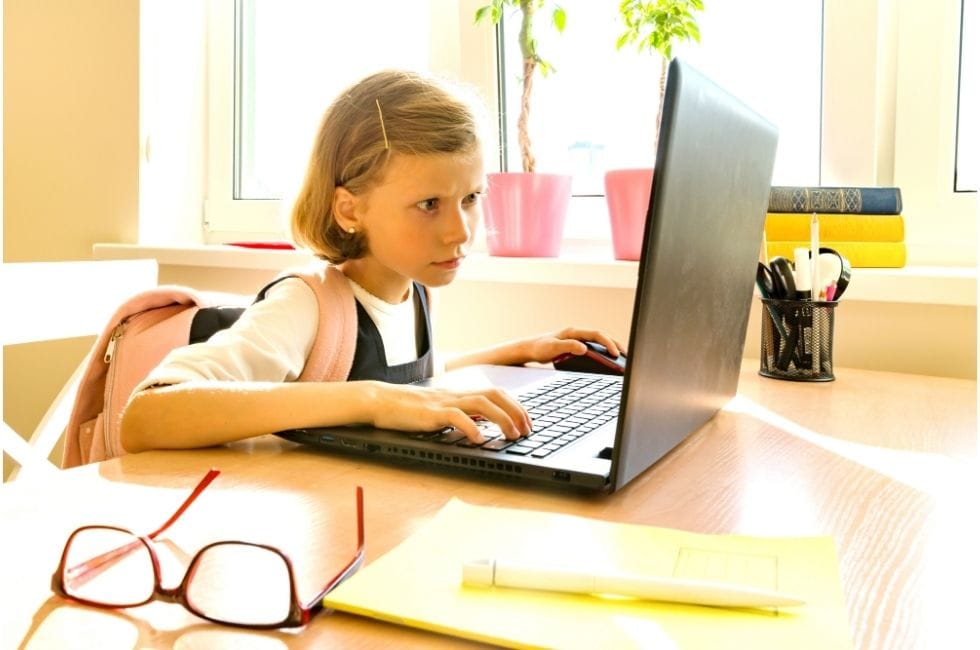
Along with the changes in lifestyles and technology in the past couple of decades, came similar changes in classrooms, teaching, the way in which information is provided and received, and the environment in which it is delivered. Technology and screens have become a big part of teaching, providing fast and easy access to information, and finding answers with just a few clicks. But this way of teaching could be costing young children dearly with its effect on their sight, focus, and interpretation of what they are seeing and learning about, according to Australian behavioural optometrist and fellow of the International Academy of Orthokeratology and Myopia Control (FIAOMC), Gary Rodney.
The Debate Goes On
He says there has been a great deal of debate about the effects of screens on children’s eyes, and the Computer Vision Syndrome caused when screens are watched for too long, which is said to cause poor eye-teaming, eye fatigue, blurred vision and dry eyes.
However, Rodney says other factors are now entering the discussion as eye experts become increasingly aware of the growing impact on vision caused by technology and lifestyle, in some cases as a result of studies-based experience during Covid-19 lockdowns.
Far Beyond Fatigue
These have led to suggestions that long spells of screen watching at one focal distance could adversely impact on children’s distance and peripheral vision (side vision) as well as their depth and perceptual vision skills, and affect their understanding of what they are seeing; and it might even contribute to the epidemic levels of myopia (shortsightedness) currently affecting one in three people globally.
He says this is supported by researchers studying myopia (nearsightedness), and its growth to epidemic levels along with the speedy growth of technology, close work, and urbanisation, which has resulted in largely indoor and screen-dominated lifestyles.
“Taking children’s natural tendency to mimic their parents’ habits into consideration, many of these researchers are increasingly focusing on this type of lifestyle when looking for a cause for myopia, instead of focusing entirely on parental genes. And their move in this direction has, in turn, been supported by studies showing a significant growth in myopia during lockdowns, particularly in young children,” Rodney says.
Cutting the Connection with Learning
According to Rodney, while technology, and specially screens, provide quick access to knowledge, and even faster answers, there is no real connection created between the viewer and the information or two-dimensional image on the screen. Nor is there a tangible one with the computer that delivers it. And as quickly as it is delivered, it can be deleted from the screen, and even from the viewer’s memory.
This lack of connection or engagement can impact considerably on children’s perceptual vision, the skill that enables them to understand what they are seeing on the screen, and its relevance in their lives. It can also lead to a loss of curiosity about knowledge, and shorter attention spans when it comes to learning.
“Studies have shown that children learn best when engaged on a person- to-person basis, whether that’s with a parent or a teacher. Perhaps it’s a throwback to a time long ago, when most children learned from their parents about how to function, behave, and survive in the real world, and learning was, more often than not, the result of demonstration, participation, observation, and practicality,” Rodney says.
HEAR: Ultra106.5FM Interview with Gary Rodney – Covid and Myopia: What you need to know!
For more information on myopia treatment and management, as well as to learn about vision therapy, or to book an appointment for a visual perception test online, visit the Smart Vision website: Optometrists Sydney: Optometry Services For Children and Adults | Smart Vision; for specific information about Myopia treatment and prevention visit Myopia Prevention: Solutions, Control And Treatment In Sydney; and for detailed information about Myopia Treatment visit Orthokeratology In Sydney: The Non Surgical Alternative.
Book an appointment for a thorough eye check-up or Call the Bondi clinic on (02) 9365 5047 or the Mosman clinic on (02) 9969 1600.
Current evidence and clinical context
A 2018 BMJ study by Mountjoy and colleagues analysed 67,798 UK Biobank participants. It used genetic variants as proxies in a method called Mendelian randomisation to investigate the direction of the relationship between education and refractive error.
A 2023 study by Clark and colleagues examined education, outdoor time and myopia using Mendelian randomisation. Accounting for outdoor time reduced the estimated education effect by about 40%. The authors concluded that outdoor time explained part, rather than all, of the relationship.
Related reading
myopia-control guide; children’s digital eye-strain guide; practical home-learning guide.
Frequently asked questions
Does education research prove a classroom screen caused my child’s myopia?
No. Population research on years of education does not identify the cause of an individual child’s myopia or isolate one classroom device.
Should a child stop studying because of myopia risk?
No. Support continued learning while discussing outdoor opportunities, comfortable working habits and appropriate eye care.
Can outdoor time replace care for diagnosed myopia?
No. Outdoor opportunities do not replace an individual management plan and follow-up for a child who already has myopia.
Related interview and local support
The original Ultra106.5FM interview with Gary Rodney about COVID and myopia provides historical context. This updated article separates the research findings from broader claims about learning.
Contact our Bondi Beach practice or Mosman practice to discuss a child’s visual symptoms and suitable assessment.